Invoices, approvals, receivables, payables, budgets, tax-ready records.
Custom ERP Development
Build an ERP that follows your business, not the other way around.
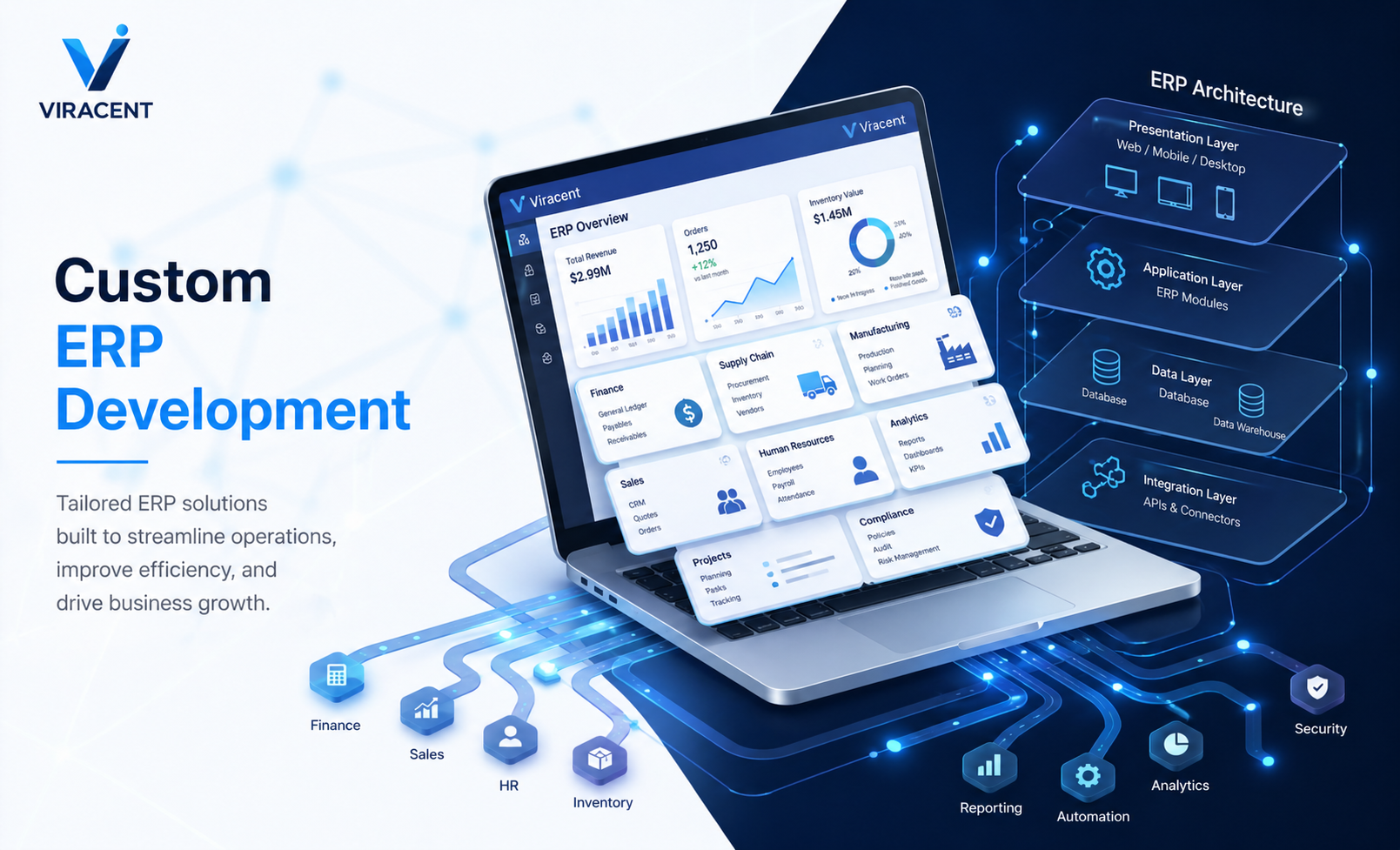
Viracent designs and engineers tailored ERP platforms that connect finance, operations, sales, procurement, inventory, HR, reporting, and customer workflows into one secure operating system for growth.
30-50%
Typical reduction in manual coordination for digitized workflows
8-14 weeks
Common timeline for a focused ERP MVP or first operational module
3-6 systems
Often consolidated into one source of truth during early phases
100%
Built around your process, roles, rules, data, and growth model
What It Means
Your enterprise nerve center, designed around real workflows.
Custom ERP Development is the design, engineering, and integration of a business management platform tailored to how your organization actually works. Instead of forcing teams into rigid off-the-shelf modules, a custom ERP maps your approvals, exceptions, dashboards, documents, customers, vendors, and compliance needs into a system people can use with confidence.
For business leaders, it creates visibility and control. For operations teams, it reduces duplicate entry and follow-ups. For technical teams, it becomes a secure, extensible architecture with clean data, APIs, role-based access, and integration points for future automation and AI.
A custom ERP is right when you need:
- Processes that standard ERP products cannot model cleanly
- One view across departments, locations, vendors, and customers
- Lower licensing friction and better fit for growing teams
- Integrations with legacy tools, cloud apps, finance, CRM, or portals
- Dashboards that show the metrics your leadership actually uses
How It Works
From operating model to working ERP.
Strong ERP delivery starts with business clarity. Viracent translates process knowledge into a modular, secure platform that can launch in phases, prove value early, and grow without becoming fragile.
What We Can Build
Modular ERP, tailored by customer requirement.
Start with the highest-value operational problem, then expand module by module. The system can be lean for a growing business or enterprise-grade for multi-location operations.
Viracent ERP Core
Workflow, Data, Roles, Reports
Stock visibility, warehouse movement, replenishment, batch tracking.
Lead-to-order flows, customer history, quotes, contracts, service requests.
Vendor onboarding, purchase requests, POs, approvals, supplier scorecards.
Job cards, projects, field teams, fulfillment, SLA and exception tracking.
Employee records, onboarding, attendance, policies, internal service desks.
Business Impact
Where custom ERP creates measurable advantage.
Speed
Reduce handoffs, spreadsheet chasing, duplicate approvals, and delayed reporting across teams.
Visibility
Bring real-time operational, financial, sales, and customer data into leadership-ready dashboards.
Control
Apply role-based access, audit trails, exception alerts, and approval rules consistently.
Adoption
Design screens around the user journey, not generic forms, so teams adopt faster with less training.
Industries We Serve
ERP patterns for operationally complex businesses.
Custom ERP is especially powerful when organizations have unique workflows, mixed systems, multi-branch operations, or compliance-heavy processes. Viracent adapts the ERP blueprint to the industry language, operational tempo, and decision model of each client.
Manufacturing
Production planning, inventory, procurement, quality, dispatch, and maintenance.
Retail and Distribution
Multi-location stock, order fulfillment, vendor terms, returns, and margin reporting.
Healthcare
Operations, billing, patient workflows, procurement, compliance, and service coordination.
Travel and Services
Bookings, suppliers, customer service, finance operations, and branch performance.
Finance and Insurance
Case management, approvals, document flows, compliance queues, and audit visibility.
Professional Services
Projects, billing, resourcing, timesheets, profitability, and client delivery dashboards.
Implementation Timeline
Practical phases, visible progress.
Every ERP roadmap depends on modules, integrations, data quality, and approval complexity. Viracent recommends phased delivery so value arrives early and the platform keeps improving.
Discovery Sprint
Process mapping, user journeys, data audit, integration review, and module prioritization.
Experience and Architecture
Workflow design, information architecture, dashboards, permissions, and technical blueprint.
MVP Build
Core modules, database, APIs, reporting, automated rules, testing, and iterative demos.
Rollout and Scale
Data migration, training, support, integrations, advanced automation, and additional modules.
Viracent Advantage
Enterprise discipline with the flexibility of custom engineering.
Viracent brings product thinking, software engineering, data architecture, cloud delivery, AI readiness, and operational consulting into one delivery model. That means the ERP is not only built correctly, it is shaped around adoption, governance, future scale, and measurable business outcomes.
Tailored to usage, not generic modules
We configure workflows, permissions, screens, and dashboards around actual customer roles and scenarios.
API-first and integration-ready
Your ERP can connect with accounting, CRM, payments, document systems, portals, cloud storage, and legacy tools.
Designed for adoption
We simplify journeys for business users while preserving the controls technical and finance teams need.
Built for future AI and automation
Clean data models and structured workflows prepare your operations for AI assistants, forecasting, and intelligent automation.
Common Questions
Clear answers before you invest.
Is custom ERP better than buying an off-the-shelf ERP?
It depends on process fit. Off-the-shelf ERP can work well for standard needs. Custom ERP is stronger when workflows are unique, licensing is restrictive, adoption is poor, or the business needs deep integrations and differentiated operations.
Can Viracent modernize an existing ERP instead of rebuilding everything?
Yes. We can extend, integrate, redesign, or gradually replace existing ERP components. A phased modernization approach often reduces risk and protects useful legacy data and workflows.
How much technical knowledge does our team need?
Business users do not need technical expertise. Viracent runs workshops in business language, translates requirements into technical architecture, and keeps stakeholders involved through demos, prototypes, and acceptance reviews.
How do you keep the ERP secure?
We design role-based access, audit trails, secure authentication, data validation, environment controls, backup planning, and integration safeguards into the platform from the beginning.
Can the ERP be tailored after launch?
Yes. A custom ERP should evolve with the business. New modules, user roles, dashboards, automation rules, and integrations can be added as priorities change.
Build Your Operating System
Let's design an ERP roadmap around your business reality.
Share your current tools, process bottlenecks, and growth goals. Viracent will help identify the first ERP module that can create visible value quickly while setting the foundation for long-term scale.